Open Education in Pennsylvania: Taking the Case to Harrisburg
For more than a decade, Pennsylvania's open education work has been library-led. Without support from a state agency or dedicated public funding, Affordable Learning Pennsylvania (ALPA) has built a statewide OER community of practice connecting librarians and educators across the Commonwealth's colleges and universities with tools, training, and resources to replace costly commercial textbooks with freely available alternatives. That program has also helped build a detailed picture of what Pennsylvania students are still up against.
In 2023, ALPA and PALCI, the Partnership for Academic Library Collaboration and Innovation, commissioned Bay View Analytics to survey Pennsylvania students on the cost and impact of their course materials. Across more than 4,000 responses from 14 institutions, 81 percent of students reported worrying about meeting their course material costs, a rate 10 points above the national average. Forty percent received no financial aid help for textbooks at all, double the national rate.
Those numbers add up fast across a state with more than 600,000 students enrolled in higher education. The survey found that 38 percent of Pennsylvania students had earned a poor grade because of course material costs, and 61 percent said those costs shaped which college they chose to attend.
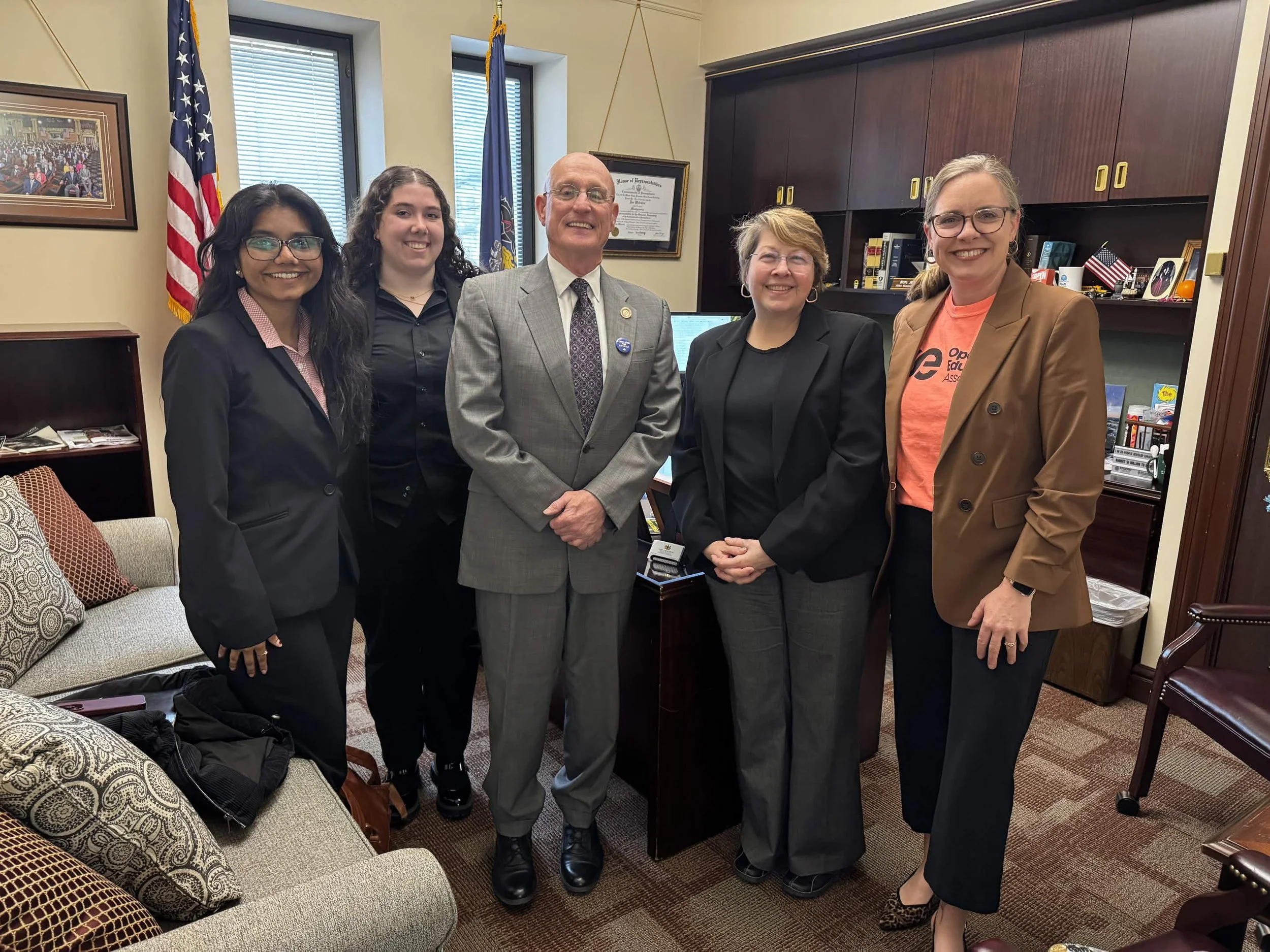
Left to right: Akshita Pawar, senior at University of Pittsburgh, Van Slavishak, freshman at University of Pittsburgh, Joe Webster, State Representative, 150th Legislative District, Marian Hampton, Affordable Learning PA, Christina Riehman-Murphy, Open Education Association & Affordable Learning PA
Pennsylvania's higher education leadership has taken notice. The State Board of Higher Education adopted its inaugural strategic plan in February 2026, identifying expanded access to open educational resources as a specific strategy for reducing course material costs, a recognition that OER has moved beyond library and instructional technology circles into mainstream higher education policy.
Open education advocates took that case to the state legislature this week. The Open Education Association joined University of Pittsburgh students and ALPA advocates at the Pennsylvania Capitol for a lobby day organized by PennPIRG, distributing a fact sheet drawing on the 2023 Pennsylvania student survey and highlighting policy approaches that have worked in other states, including OER grant programs and course catalog transparency requirements.
Among the topics discussed with lawmakers was dual enrollment, where the connection to OER is particularly promising. Pennsylvania introduced HB 1434 in 2023 to establish a dual credit grant program with OER adoption as an explicit allowable use of funds. The bill passed the House but did not advance in the Senate. As dual enrollment continues to grow nationally and the question of who pays for course materials becomes harder to ignore, Pennsylvania has a ready foundation to build on.
Pennsylvania has built something real in open education without the formal structures many other states have relied on. What ALPA and the broader community have demonstrated is that the demand is there, the practitioners are there, and the student need is documented. The conversations happening now are about making sure that foundation has room to grow.