
Upcoming Events
Student Rights in the Era of AI: What It Means for Open Education
This event has concluded, but you can watch the recording.
Artificial intelligence is reshaping the student experience in higher education, often faster than institutions can establish clear protections. Hosted by the Open Education Association, this webinar explores what students are owed as AI becomes embedded in their education, and what open education practitioners can do about it.
The session will open with a presentation from Student Defense, introducing their Student AI Bill of Rights and the principles it establishes around transparency, human oversight, data ownership, safety, and access to AI's benefits. This will be followed by a panel discussion connecting these rights to the realities of OER and open pedagogy work, including questions of student data, authorship, agency, experience, and access. The webinar will close with time for informal discussion among attendees.
Whether you're new to thinking about AI and student rights or already grappling with these questions in your own practice, this webinar will offer a grounding in the Student AI Bill of Rights and offer practical perspectives from faculty, librarians, and students on what it means for open education.
Presenter:
Dan Zibel, Vice President & Chief Counsel, Student Defense
Dan Zibel is the Vice President & Chief Legal Counsel of Student Defense. He has substantial experience working on consumer protection issues in higher education, and the authority of the U.S. Department of Education (ED) to oversee schools and other participants in Federal Student Aid programs. Before co-founding Student Defense, he served as the Deputy Assistant General Counsel for Postsecondary Education in ED. He’s currently a litigator on several Student Defense lawsuits, including protecting SNAP recipients’ data from government overreach, and attempting to stop the Trump administration’s dismantling of ED. He also co-leads Student Defense’s Safeguarding Higher-Ed Through AI Practices & Ethics (SHAPE) AI Initiative. It launched in September 2025 to provide strategic guidance, policy recommendations, and educational resources that promote ethical, responsible, student-friendly, and transparent uses of AI in higher education.
Panelists:
Amber Lynn Anderson, Master’s Student in Professional and Technical Writing, University of Arkansas at Little Rock
Amber Lynn Anderson is a nonfiction editor and master’s student in Professional and Technical Writing at the University of Arkansas at Little Rock, where she recently earned her BA in Professional and Technical Writing. As an undergraduate, she participated in an open-pedagogy project in Advanced Editing, serving as a co-author of Open Professional and Technical Editing with Handbook, an open textbook designed to support students and educators in the field. Her interests include nonfiction writing, editing, and teaching college-level writing courses.
Virginia Clinton-Lisell, Professor, Education, Health & Behavior, University of North Dakota
Virginia Clinton-Lisell, PhD, is a Professor in Educational Foundations and Research at the University of North Dakota. She holds a masters’ degree in Teaching English to Speakers of Other Languages from New York University and a doctorate in Educational Psychology from the University of Minnesota. Dr. Clinton-Lisell’s research focuses on digital reading comprehension and open education. She is the Primary Researcher for the Open Education Group, which provides mentorship and support for early career researchers on open education projects.
Tiffani Tijerina, Assistant Professor of Rhetoric and Writing, University of Arkansas at Little Rock
Tiffani Tijerina, Ph.D., is an Assistant Professor of Rhetoric and Writing at the University of Arkansas at Little Rock. She holds a Ph.D. in Technical Communication and Rhetoric from Texas Tech University and an M.A. in Instructional Design and Technology from Georgia State University. Dr. Tijerina’s research and teaching focus on technical and professional writing and editing, open education, and instructional design. She is the editor of the Open Education Award-winning Pedagogy Opened: Innovative Theory and Practice, first author of the Open Education Award-winning Open Technical Communication 1e and 2e, and faculty author of the recently published open pedagogy project Open Professional and Technical Editing with Handbook.
David Tully, Principal Librarian for Student Affordability, North Carolina State University
David Tully serves as the Principal Librarian for Student Affordability at NC State University Libraries, overseeing the dual pillars of open education and student scholarship fundraising. He advances open education as a tool for both cost reduction and pedagogical enrichment, helping faculty create flexible, student-centered learning environments. Additionally, David leads strategic fundraising and management for the student scholarship program, partnering with donors to deliver direct financial relief and create opportunities for long-term student success.
The first 60 minutes of this webinar will be recorded and made available following the event.
Beyond Echo Chambers: Bringing Open Education to New Audiences
This event has concluded, but you can view the slides and watch the recording.
Open education has made meaningful progress, yet the case hasn't reached many of the spaces where it could have an even greater impact. This webinar is for practitioners ready to take open education outside familiar circles. It will cover practical strategies for framing open education for new audiences and making the case in unfamiliar rooms, highlighting presenting at conferences as one concrete avenue for this work.
The session will begin with a framing presentation, followed by a panel discussion. The speakers bring firsthand experience doing this across a range of contexts, from government and policy to fields well beyond the open education community. The webinar will be recorded and made available after the event.
Presenter:
Lindsey Gwozdz, Assistant Dean of Library, Community College of Rhode Island
Panelists:
Amanda Coolidge, VP Strategic Engagement and Growth, Pressbooks
Ethan Senack, Assistant Director of Ops and Development, Partnership for Large Election Jurisdictions
Liliana Diaz Solodukhin, Senior Program Officer, Ascendium Education Group
Audience: All are welcome
OpenEd25 Keynote Rewatch: adrienne maree brown
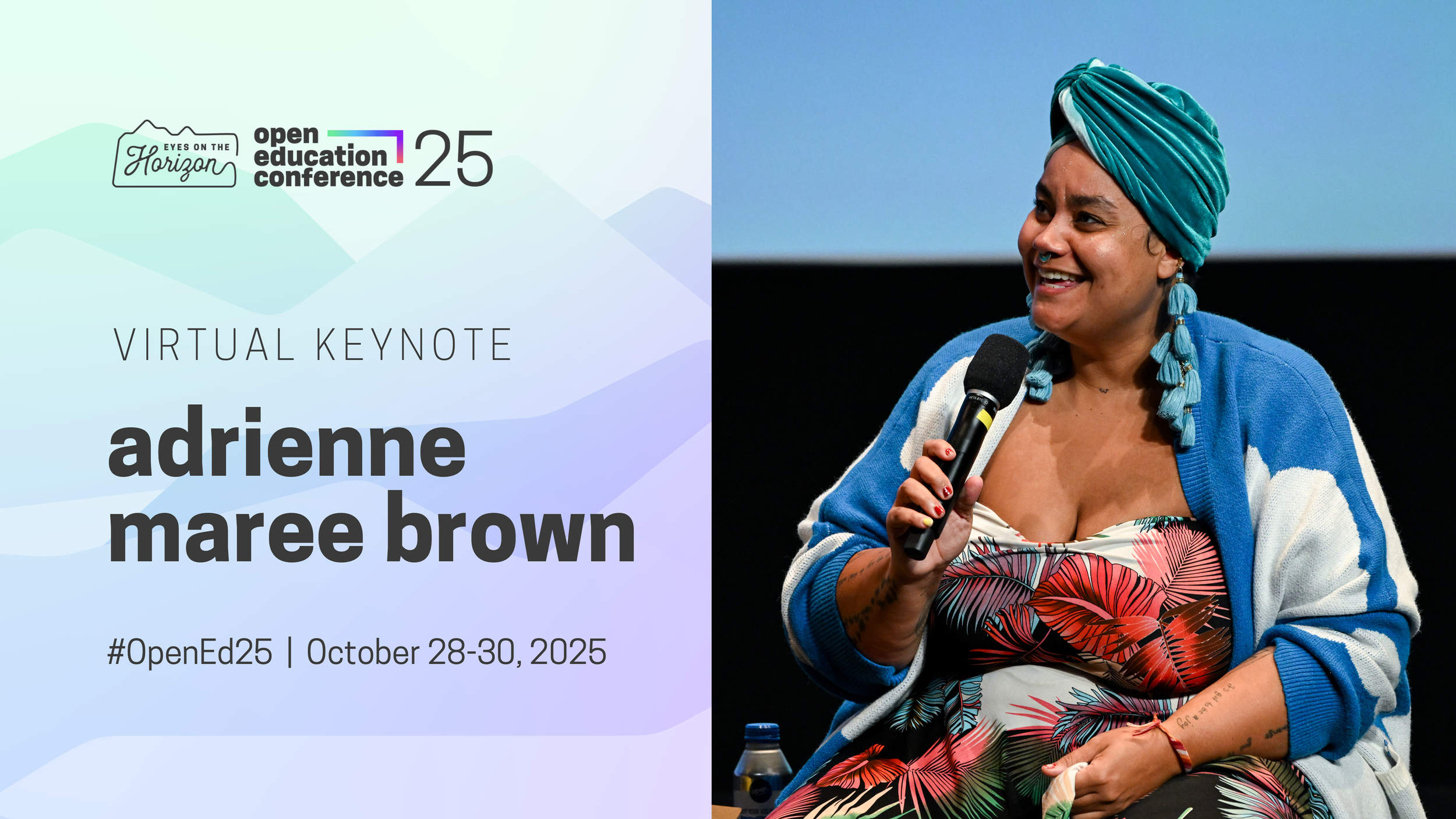
The Open Education Association invites you to a virtual rewatch of bestselling author adrienne maree brown’s keynote from the 2025 Open Education Conference. Drawing on decades of movement facilitation, science fiction scholarship, and community care, this keynote invites participants to reflect on transformation, imagination, and the practices that help communities grow and heal.
All are welcome to attend this virtual “rewatch party,” which will feature a livestream of the keynote and live chat in Zoom. After the recording, attendees are welcome to stay for an optional discussion.
This event will not be recorded, but a recording of the keynote is available to watch anytime from the Open Education Conference.
OpenEd25 Keynote Rewatch: Dr. Kim Hunter Reed
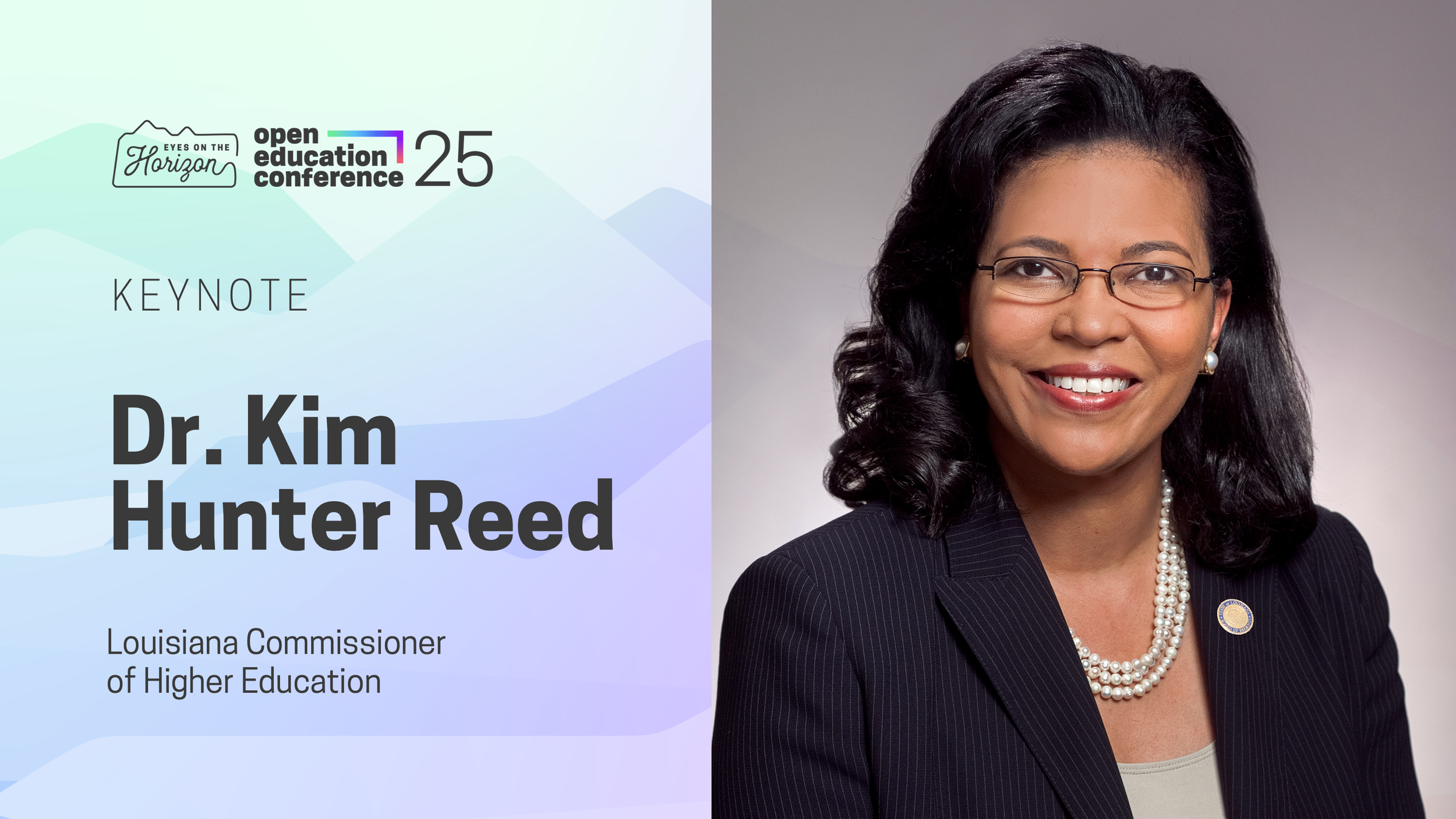
The Open Education Association invites you to a virtual rewatch of Louisiana Higher Education Commissioner Dr. Kim Hunter Reed’s keynote from the 2025 Open Education Conference. Entitled New Horizons: Opening Doors and Transforming Lives Through Higher Ed in Louisiana, this inspiring talk explores how to pave the way toward more affordable and accessible higher education through bold policy, open innovation, and strategic investments in resources, partnerships, and programs that prioritize student success.
All are welcome to attend this virtual “rewatch party,” which will feature a livestream of the keynote and live chat in Zoom. After the recording, attendees are welcome to stay for an optional discussion.
Audience: All are welcome
This event will not be recorded, but a recording of the keynote is available to watch anytime from the Open Education Conference.


Community Event Lists
-
![]()
Open Education Conference List
-
![]()
Open Education Webinar Calendar

