Maintaining Momentum for OER in Connecticut
Connecticut has taken a deliberate approach to building open education capacity at scale. Through the Connecticut Open Educational Resources Coordinating Council, established by the legislature in 2019, the state has created a sustained infrastructure for open education that spans faculty grant programs, professional development, statewide summits, and a growing body of data on how OER is being used across its colleges and universities.
The results are striking. To date, the Council's work has saved more than 10,000 students nearly $1.2 million in textbook costs, a return of more than five dollars for every state dollar invested in grants. And that figure likely understates the full impact: only about 7 percent of high-impact course sections at Connecticut institutions are currently using OER, meaning the potential for student savings is far greater than what has been realized so far. The Council estimates that if OER were used across all high-impact sections, students could save an estimated $37 million annually.
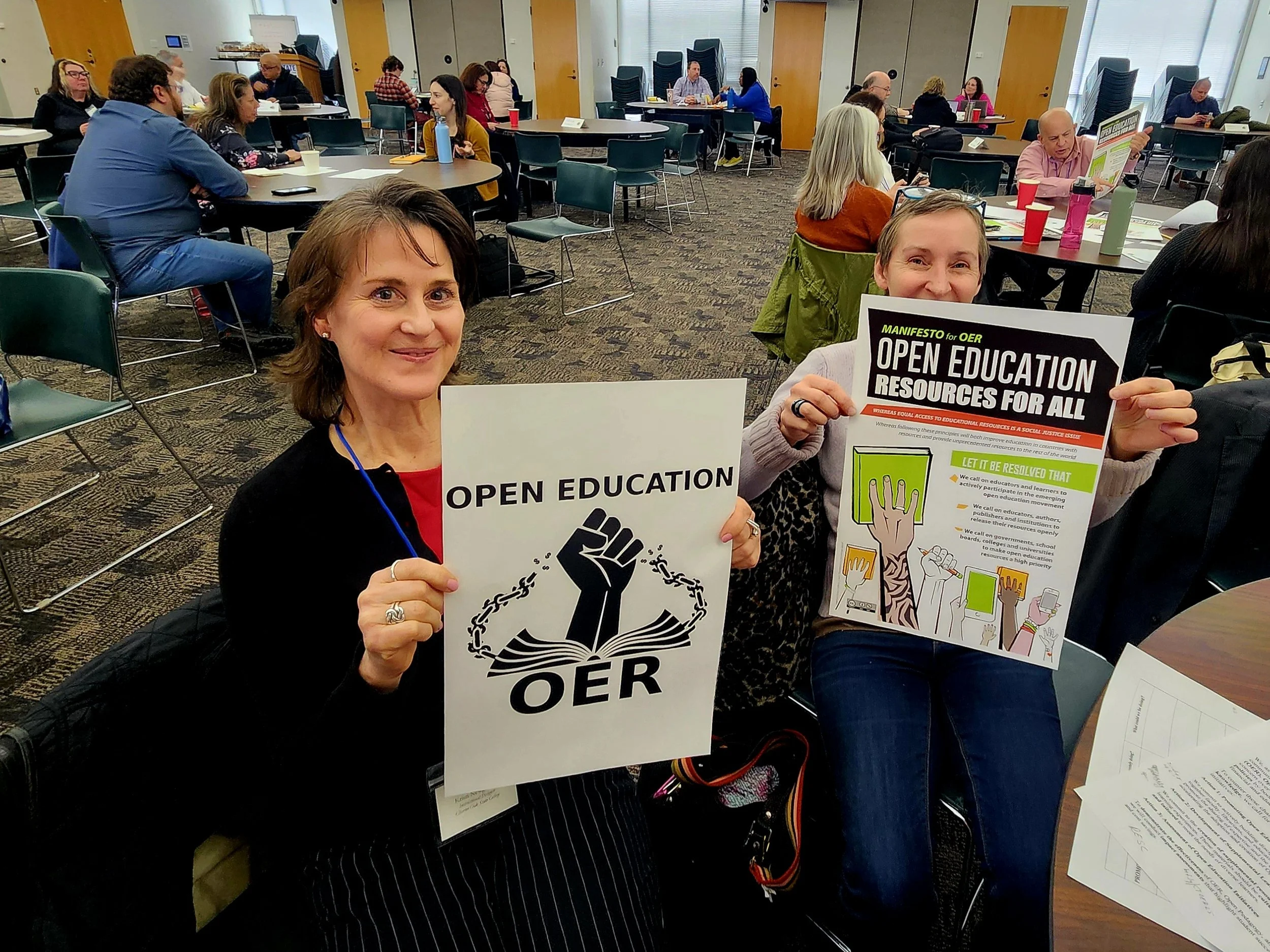
Kristi Newgarden (left), Instructional Designer at Charter Oak State College and Aura Lippincott (right), Instructional Designer at Western Connecticut State University at last year’s CT OER Summit.
How much of that potential is realized depends on continued state investment. Connecticut eliminated its OER funding entirely in FY2024, and while a partial restoration of $50,000 annually has allowed core activities to resume, it remains half of the Council’s previous level.
With the FY2027 state budget now under consideration, the Open Education Association joined state leaders in submitting testimony to the Appropriations Committee on February 19th, making the case that the program's track record warrants a return to full funding.
The demand is there. A recent state survey found that the greatest area of need is incentives for faculty — exactly what the Council's grant program provides. The Council had already received 27 applications for its current grant cycle, and anticipates fully expending its available funds. More resources would mean more grants, more courses converted to OER, and more students with access to free course materials.
Beyond the grant program, the Council continues to advance the field in other ways. It recently published a Model OER Policy that colleges and universities across the state can adapt, developed resources on automatic textbook billing to help institutions navigate that landscape, and hosts an annual CT OER Summit that brings together faculty, librarians, administrators, and students from across the state.
The Open Education Association will participate in the 2026 CT OER Summit on March 13th and looks forward to connecting with the Connecticut community. If you're attending, we hope to see you there.