
Member Spotlight: Megan Zara
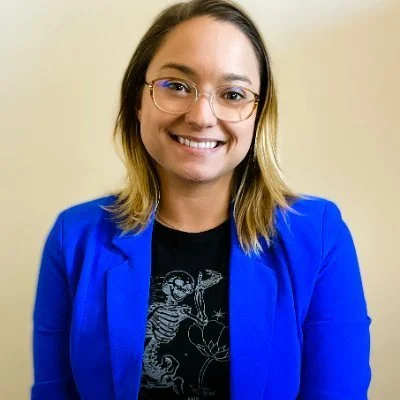
For UT Arlington’s Open Educational Resources Librarian, learning is about care and co-creation.
For Megan Zara, open education is a story she’s been living long before she had the language to describe it. In first grade, she watched her mother volunteer in the classroom, pregnant and determined, while studying for the GED she never got to earn as a teenager. Years of homelessness, full-time work, and raising children cemented her mother’s belief that learning could be a lifeline. “That shaped me,” Megan says. “It taught me that people who are struggling deserve care, not judgment.”
Now the Open Educational Resources Librarian at the University of Texas at Arlington, Megan carries that inheritance into every corner of campus. As she searches out free and open learning resources for students, or helps faculty reimagine their courses through open pedagogy, she builds a bridge between the classroom and the broader community. Really, her job is about refusing the quiet cruelties higher education has normalized: students skipping meals to buy access codes, faculty feeling boxed into expensive systems, knowledge treated like a luxury good. Megan knows that world firsthand. “I am still being crushed by student debt,” she says. In college, she tried to go without books, bought them too late, paid full price too often, resold them for pennies. “I am going back into the fire to help others out.”
At UTA, Megan weaves the philosophical with the practical. Her anchor question is: “Who gets to learn, and who decides what learning looks like?” She loves the moment when an instructor realizes they’ve been doing open work all along, or when a student discovers that textbooks can be free, and that their ideas can shape a course. In those small shifts is a recalibration of power: learning as something co-created, not consumed.
Looking forward, Megan hopes the field stops treating OER as “free stuff” and starts seeing open education as a reimagining of relationships—supported by funding, protected faculty time, and acknowledgement of OER work as academic contribution. She envisions students as co-authors of courses that center cultural relevance and accessibility, explicitly connecting the work to movements for racial, economic and disability justice. “My dream is that, when people hear “open,” they immediately think about belonging, possibility, and shared power.”
Want to share your story or nominate someone else? Complete the form.